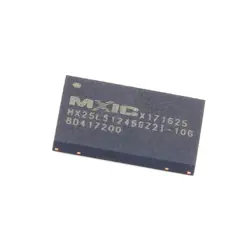
Images à titre indicatif uniquement
HMC8038LP4CETR
+NomenclatureIC RF SWITCH SPDT 6GHZ 16LFCSP
-
FabricantAnalog Equipment GmbH.
-
Pièce fabricant #HMC8038LP4CETR
-
Fiche technique HMC8038LP4CETR DataSheet
-
Package 16-VQFN Exposed Pad, CSP
-
En stock7752
365 Garantie qualité 24h/24
7*24 Garantie de service 24h/24
90-Garantie après-vente 24h/24
Garantie produit authentique
Spécifications
| Attribut | Valeur |
| Package | Tape & Reel (TR),Cut Tape (CT) |
| ProductStatus | Active |
| RFType | Cellular |
| Topology | Absorptive |
| Circuit | SPDT |
| FrequencyRange | 100MHz ~ 6GHz |
| Isolation | 60dB |
| InsertionLoss | 0.8dB |
| TestFrequency | 100MHz, 6GHz |
| P1dB | 36dBm |
| IIP3 | 60dBm |
| Impedance | 50Ohm |
| Voltage-Supply | 3.3V ~ 5V |
| OperatingTemperature | -40°C ~ 105°C |
| Package/Case | 16-VQFN Exposed Pad, CSP |
Présentation
Description
The device is built in a compact 4x4 mm LFCSP package, enabling efficient space utilization in densely packed circuit boards. It features high linearity, low conversion loss, and excellent LO-RF and LO-IF isolation, which contribute to improved signal integrity and system performance.
The HMC8038LP4CETR is designed to work with a wide range of local oscillator (LO) power levels, and it provides flexibility in terms of input and output frequency planning. Additionally, its robust design and reliable performance make it a preferred choice for engineers designing sophisticated RF systems that demand precision and efficiency.
Equivalent
1. Analog Devices HMC540A: Another wideband voltage-controlled attenuator.
2. Peregrine Semiconductor PE4312: A digital step attenuator offering similar functionality.
3. Qorvo QPC3024: A voltage-controlled attenuator with broadband capabilities.
When considering equivalents, ensure compatibility in terms of frequency range, power handling, and other specifications relevant to your application.
Features
Pinout
This component is commonly used in applications such as phased array antennas, beamforming networks, and other systems requiring phase adjustment. The digital control interface is straightforward and typically consists of logic-level input pins that accept the binary control word to set the desired phase shift.
For detailed pin configuration, functions of each pin, and electrical characteristics, referring to the manufacturer's datasheet is recommended. The datasheet will provide explicit details on the pin layout, electrical specifications, and application guidelines.