
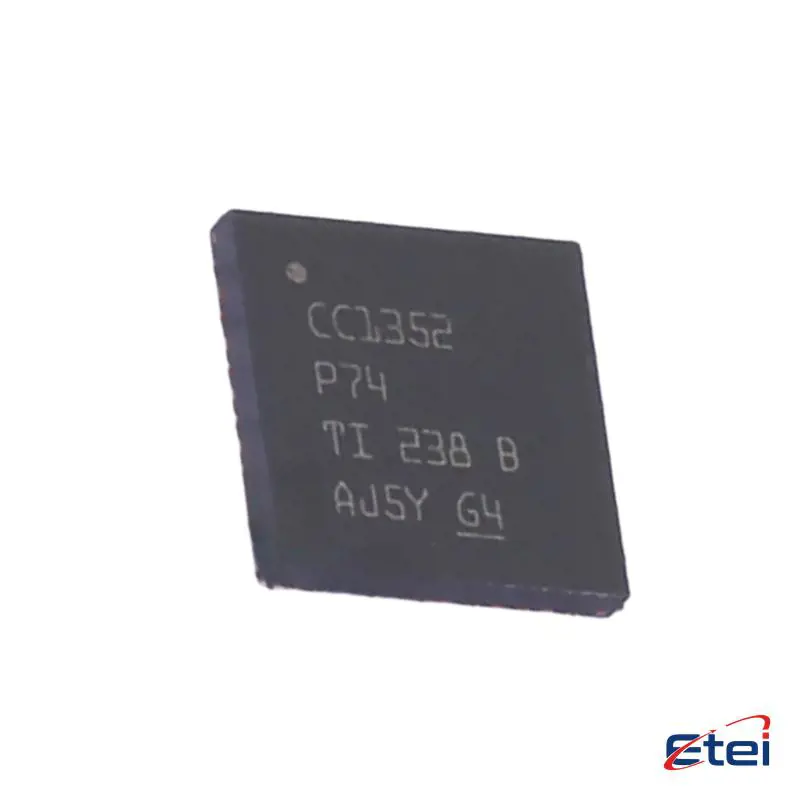
Images à titre indicatif uniquement
CC1352P74T0RGZR
+NomenclatureIC RF TXRX+MCU 802.15.4 48VQFN
-
FabricantTexas Instruments
-
Pièce fabricant #CC1352P74T0RGZR
-
Fiche technique CC1352P74T0RGZR DataSheet
-
En stock4155
365 Garantie qualité 24h/24
7*24 Garantie de service 24h/24
90-Garantie après-vente 24h/24
Garantie produit authentique
Spécifications
| Attribut | Valeur |
| Series | SimpleLink™ |
| Part Status | Active |
| Type | TxRx + MCU |
| RF Family/Standard | 802.15.4, Bluetooth |
| Protocol | Bluetooth v5.2, Thread, Wireless M-Bus, Zigbee® |
| Modulation | DSSS, FSK, GFSK, O-QPSK |
| Frequency | 287MHz ~ 351MHz, 359MHz ~ 527MHz, 861MHz ~ 1.054GHz, 1.076GHz ~ 1.315GHz, 2.36GHz ~ 2.5GHz |
| Data Rate (Max) | 2Mbps |
| Power - Output | 20dBm |
| Sensitivity | -121dBm |
| Memory Size | 704kB Flash, 144kB RAM |
| Serial Interfaces | ADC, GPIO, I2C, I2S, SPI, UART |
| Voltage - Supply | 1.8V ~ 3.8V |
| Current - Receiving | 5.4mA ~ 7.1mA |
| Current - Transmitting | 8mA ~ 101mA |
| Operating Temperature | -40°C ~ 105°C (TA) |
| Mounting Type | Surface Mount |
| Package / Case | 48-VFQFN Exposed Pad |
| Supplier Device Package | 48-VQFN (7x7) |
| Base Product Number | CC1352 |
| DigiKey Programmable | Not Verified |
| GPIO | 26 |
Présentation
Description
It is equipped with an ARM Cortex-M4F processor, offering efficient processing capabilities and a range of peripherals. The device supports multiple protocols, including Zigbee®, Thread, Bluetooth® Low Energy, and proprietary RF systems, offering flexibility for various wireless applications. Its low power consumption is ideal for battery-powered devices, and it has multiple low-power modes to extend battery life. The CC1352P7 also includes robust security features to ensure safe communication, making it a reliable choice for IoT solutions.
Equivalent
1. Silicon Labs EFR32FG23 - Supports dual-band wireless protocols with similar low-power capabilities.
2. Nordic Semiconductor nRF52840 - Offers Bluetooth 5 and Thread/Zigbee support with comparable power performance.
3. NXP KW41Z - Supports Bluetooth Low Energy and IEEE 802.15.4 radio capabilities suitable for similar applications.
These alternatives offer overlapping functionalities, though specific feature sets may differ.
Features
1. Dual-Band Support: Operates in both Sub-1 GHz and 2.4 GHz frequency bands, providing flexibility for various wireless protocols like Bluetooth 5.1 Low Energy, Zigbee, Thread, and proprietary RF.
2. Integrated Power Amplifier: Features a high-output power amplifier for extended range and improved link robustness.
3. Ultra-Low Power: Optimized for low power consumption with multiple sleep modes, suitable for battery-powered applications.
4. Processing Power: Equipped with an Arm Cortex-M4F processor running at up to 48 MHz, providing ample processing power for complex applications.
5. Memory Options: Includes up to 352 KB Flash memory and 80 KB of SRAM.
6. Security Features: Offers hardware security features such as AES-128/256, SHA2, and a true random number generator.
7. Development Tools: Supported by TI's software development kit and a range of development tools for easy integration and rapid development.
These features make the CC1352P74T0RGZR suitable for smart home, industrial, and other IoT applications demanding versatile wireless connectivity and low power usage.
Pinout
The pin functions include power supply pins, digital I/O pins, analog input pins, and pins for RF communication. Key interfaces supported by these pins are:
- Analog inputs for ADC functionality
- Multiple GPIOs for general-purpose digital input/output
- UART, SPI, and I2C for serial communication
- Pins for RF output and antenna connection
- Debug and programming interfaces
The device is designed to be versatile for low-power applications, with integrated power management features. Each pin can have multiple configurations depending on the software setup, supporting various peripheral interfaces and functionalities necessary for wireless communication and sensor interfacing.


